

Best Pharma Launch Excellence Partners in 2026: Consultancies, Commercialization Services, and AI Platforms Compared

Pharma launch excellence is the cross-functional discipline that carries a new drug from launch readiness through its first 12 to 18 months on market, covering forecasting and launch planning, payer coverage and prior authorization (PA) pull-through, healthcare professional (HCP) adoption, specialty pharmacy (SP) and hub performance, field deployment, and the recurring check of new-to-brand prescriptions (NBRx) and new-patient starts against plan.
The best pharma launch excellence partner depends on the job. ZS, IQVIA, Trinity and Acumetis have the deepest documented practices for planning a launch. EVERSANA, Syneos Health, Inizio and IQVIA supply the field teams, hubs and patient services that execute it. Tellius gives commercial teams AI workers that manage performance continuously, while Veeva, Komodo Health and ODAIA cover targeting and specific data feeds. Most launch teams combine one partner from each group.
The stakes are high on both sides of approval. Bringing a new drug to market took a median capitalized R&D investment of about $985 million in a 2020 JAMA analysis (JAMA), while McKinsey's research on launches from 2003-2009 found that about two-thirds missed prelaunch consensus sales expectations in their first year, and that launches that started behind tended to stay behind (McKinsey). This guide reviews 14 partners against that first year: what each supplies, what it leaves to someone else, and what to verify before you sign.
Disclosure: Tellius publishes this guide and is one of the 14 providers reviewed. The review method below applies to every provider, Tellius included.
How we reviewed providers
We reviewed 14 providers from their own published materials in late September and early October 2026, and we describe what each documents rather than scoring them.
Sources were each company's website, product pages, help documentation, press releases and published case studies, read between September 29 and October 7, 2026. Where a provider describes a capability without saying how it's delivered, the profile says so and names the question to ask in a demo.
A provider made the list if it had a documented offering relevant to US launch teams and enough published information to describe its role in a launch without guessing. The list is selected, not exhaustive. McKinsey and Blue Matter both run launch strategy practices that meet those criteria, and a team choosing a strategy partner should include them in its search. We kept the strategy-only group to the firms profiled here. Aktana and PharmaForceIQ, now merged, focus on next-best-action for field teams and are covered in the pharma field force effectiveness comparison.
Which pharma launch excellence partners cover which launch responsibility?
Launch excellence breaks into three responsibilities: plan the launch, execute it, and manage performance continuously once data lands. No partner in this guide covers all three alone.
Why do pharma launch excellence programs stall after approval?
Most launch programs get months of attention before approval and much less once the data starts landing, so the reason behind an off-plan month tends to arrive after the month is over.
Readiness gates, analog forecasts, pricing and access strategy, field sizing and hub design get a dedicated PMO (project management office) before approval, and most partners in this guide do that work well. The pressure shifts with the first data cuts, when new-patient starts come in under plan and the question becomes why, and where. The answer rarely sits in one feed. Covered lives can look healthy while PA denials cluster in two regional plans, hub enrollments stall at benefits verification, or a specialty pharmacy is slow to dispense. Checking every territory, plan and writer segment each cycle is too much to do by hand.
In most programs that investigation happens inside an engagement. A question raised in the launch review gets scoped, and the answer arrives in a deck after another cycle of data has landed. Hiring a partner makes sense for strategy, pricing, field deployment and patient services, where the partner brings experience from other launches and staff the brand team doesn't have. The performance investigation is different in two ways. It repeats every data cycle for as long as the brand is on market. And each answer builds on decisions made in earlier ones, such as how NBRx is counted, which territories are excluded from plan, and whether a jump in PA denials was treated as a payer policy change. When an outside team does the investigation, those decisions live in its files and leave when the engagement ends.

How is pharma launch excellence different from pharma commercialization services?
Pharma commercialization services supply the capacity to execute a launch, while launch excellence decides where that capacity goes and checks whether it's working.
Commercialization services cover contract sales, 3PL, hub and patient support, and medical information. Launch excellence covers the plan, the governance and the recurring review that direct that capacity. EVERSANA, Syneos Health, Inizio and IQVIA sell both.
How mature is your pharma launch excellence program?
Programs move from planning a launch, to tracking it, to diagnosing it, to running the recurring work on a schedule, to watching between reviews. Most stall between tracking and diagnosis.
Every team in this guide has a launch plan, so the levels start there. What separates them is how quickly a number that moved becomes a cause, and how much of that depends on someone making a new request.
Level 1: Planned. Readiness gates, analog forecasts, a KPI (key performance indicator) framework and a launch PMO are in place before the PDUFA date. In market, the read is a monthly deck comparing actuals with forecast. Strategy consultancies and planning tools like Trinity's Launch Accelerator do their strongest work here.
Level 2: Tracked. Trackers on syndicated Rx, SP and hub data show what moved: NBRx by territory, PA approval rates, abandonment, time to therapy. IQVIA launch tracking, Veeva Compass, Komodo Health's projections and ZoomRx's awareness tracking supply this level. The why still arrives through an analyst or partner, one question at a time.
Level 3: Diagnosed. A gap gets broken down across feeds on demand, with contributors ranked by payer, territory, specialty and writer segment and each figure traced to its source. IQVIA.ai, ZS ZAIDYN, Axtria InsightsMAx.ai and Syneos Health's Kinetic bring AI agents to this level, usually alongside the firm's own data or services teams. Tellius works here as software the brand team runs.
Level 4: Run. Launch reviews, payer investigations and territory briefs arrive prepared on a schedule, the same governed logic reruns each cycle, and last cycle's approved actions are checked for status. Tellius builds its AI workers for this level. We couldn't confirm scheduled, prepared launch reviews in the other providers' public materials, though IQVIA.ai and the agent platforms from ZS and Axtria come closest.
Level 5: Always on. AI workers check each new data cut against plan between reviews, flag a shift when it lands (a plan tightening PA criteria, starts dropping in three territories, a hub backlog building), and prepare a proposed response before the next review. Tellius AI workers run these watches alongside the scheduled reviews.
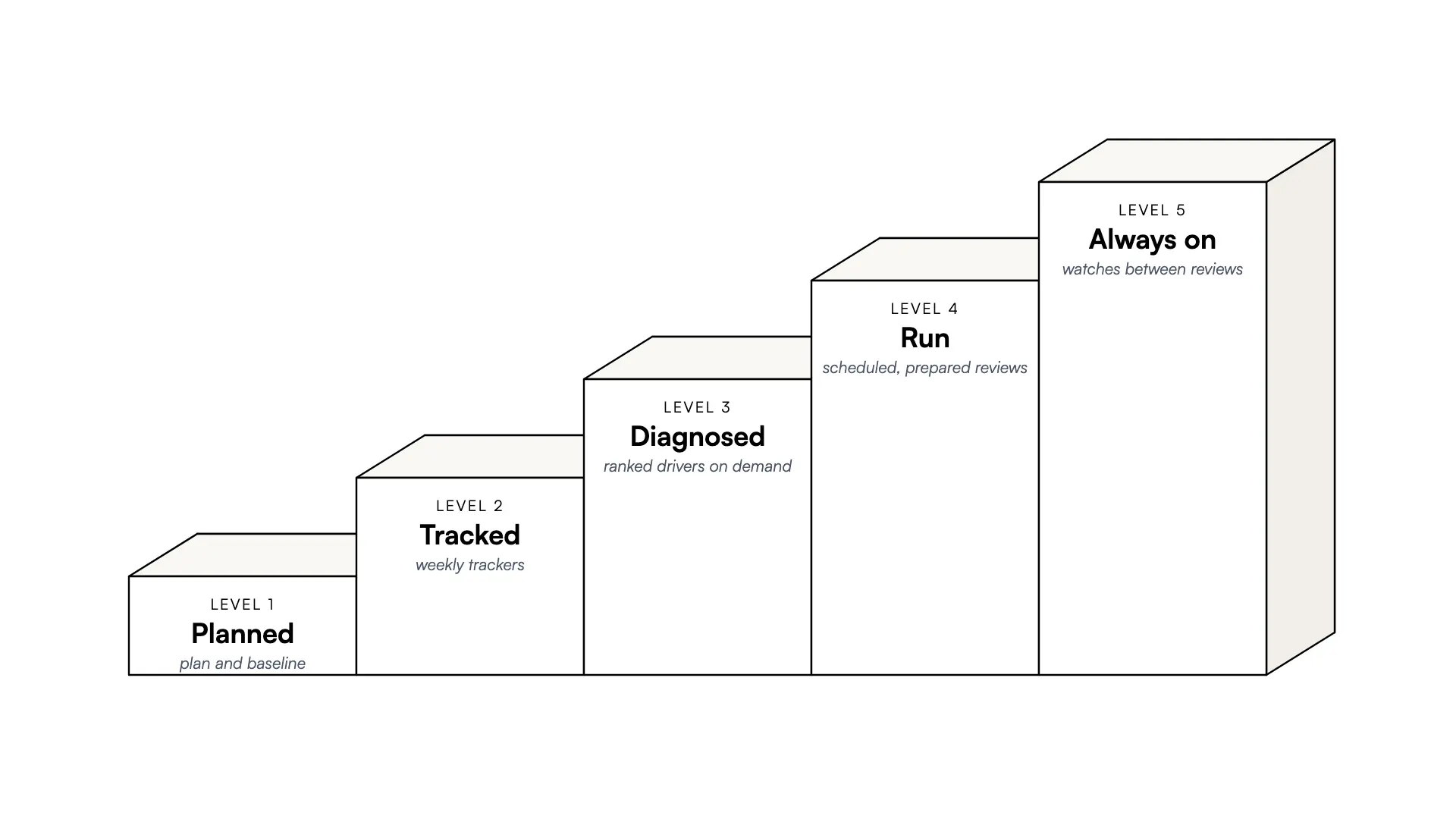
To place your own program, take last month's biggest launch question and count the days between asking it and acting on the answer. If that count depended on someone scoping the work, the program sits at Level 2, whatever the dashboards look like.
How do the 14 pharma launch excellence partners compare in detail?
No partner covers planning, execution and continuous performance management equally, so each profile names what the provider does well, what you'll need from someone else, and what to verify.
Profiles follow the three launch responsibilities, alphabetically within each. Several providers span more than one, so each sits where its strongest documented work is.
Plan the launch: Acumetis, Deloitte, IQVIA, Trinity and ZS
Acumetis: strategy, access and patient-program design
Acumetis formed in April 2026 from Herspiegel, Adivo, Decisive, Fiecon and Sixsense. It covers commercial strategy, launch excellence, market access and health economics and outcomes research (HEOR), patient access and support program design, and insights.
Where Acumetis excels: launch strategy, access evidence and patient-program design come from one specialist firm.
Where Acumetis falls short: it designs hub and support programs rather than operating them, and it offers no analytics software a launch team runs itself, so in-market diagnosis happens through consulting cycles.
Consider if the launch hinges on payer value evidence and patient-program design, and you'll staff execution elsewhere.
Deloitte: strategy plus systems integration
Deloitte brings life sciences strategy through Monitor Deloitte, a Launch and Value Center of Excellence in Europe, commercial analytics, and CRM (customer relationship management) and data platform builds.
Where Deloitte excels: the same firm sets the launch strategy and builds the CRM and data systems behind it, which the client keeps.
Where Deloitte falls short: we couldn't find a dedicated US launch excellence offering in its public materials, and launch diagnosis beyond the build is further consulting work.
Consider if the launch needs new CRM and data infrastructure and you want the strategy and the build from one firm.
IQVIA: syndicated data, launch strategy and field capacity from one partner
IQVIA pairs the syndicated prescription and patient-level data many launch teams already license with consulting, outsourced commercial services and, since March 2026, IQVIA.ai, an agentic AI platform with ready-to-use and configurable agents for clinical and commercial work.
- Launch strategy, readiness and forecasting through its Launch Strategy and Management practice
- Syndicated Rx and patient-level claims data it owns
- IQVIA.ai conversational AI and agents, with more agents planned for late 2026
- Outsourced engagement, including contract field teams
Where IQVIA excels: a brand gets the data, the launch strategy, the field capacity and an agent platform from one partner, and the agents run on data the team already buys.
Where IQVIA falls short: a hub provider's case data, another vendor's claims or CRM call notes need integration work before IQVIA.ai can use them alongside IQVIA data.
What to verify: which launch questions IQVIA.ai agents answer today and which still run through IQVIA services teams, how feeds IQVIA doesn't own get joined to its data, and how a figure in an agent's answer traces back to its query and source rows.
Pricing: data subscriptions plus engagement-based services. Not published.
Consider if you want one partner for syndicated data, launch strategy and contract field capacity, and you're comfortable with the in-market investigation running largely inside IQVIA's services and data.
Trinity: benchmark-led launch planning
Trinity is a life sciences consultancy with a Launch Excellence practice, TGaS benchmarking data, and Launch Accelerator, a benchmark-based planning tool that Trinity or a client's own launch team configures and runs.
Where Trinity excels: plans start from what comparable launches did, and the planning tool stays with the client team after the engagement.
Where Trinity falls short: Launch Accelerator manages the launch plan, not the in-market investigation, so explaining why starts lag runs through Trinity's analytics services. Trinity doesn't own syndicated data, deploy field teams or operate a hub.
Consider if your launch plan needs pressure-testing against benchmarks and you want a planning tool your own PMO keeps running.
ZS: launch strategy and analytics on its own platform
ZS is a commercial consulting firm that runs much of its analytics work on its own software platform, ZAIDYN. ZS sells ZAIDYN as self-serve products and through professional services that cover implementation, configuration, integration, enablement, managed support and ongoing optimization under each client's scope of work (AWS Marketplace listing). It added agentic product suites for medical and content teams in May 2026 (ZS newsroom).
- Launch strategy, forecasting and scenario modeling
- Pricing and market access advisory
- Field force sizing, targeting and IC design
- ZAIDYN Commercial for field performance, customer engagement and analytics
Where ZS excels: strategy and analytics come from the same firm, ZAIDYN stays in place after a project closes, and the customer chooses how much of the platform ZS operates.
Where ZS falls short: it doesn't own syndicated data, deploy field teams or operate a hub. ZAIDYN's public materials describe self-serve products and configurable solutions, but not how a brand team adds a measure, changes analytical logic or builds a new recurring review without ZS involvement. We couldn't confirm scheduled, prepared launch reviews in its public materials.
What to verify: under the delivery model you're buying, which changes your team makes alone, which need ZS specialists, and what each costs. The Tellius vs ZS section below lists five tasks to ask about.
Pricing: engagement-based consulting plus ZAIDYN licensing. Not published.
Consider if you want strategy, forecasting and analytics from one firm and expect it to stay involved through the first launch year.
Execute the launch: Axtria, EVERSANA, Inizio, Komodo Health, ODAIA, Syneos Health and Veeva
Axtria: launch operations on software you license
Axtria sells commercial software and services to life sciences companies, including a packaged Axtria Launch Excellence program that covers pre-launch consulting, readiness and post-launch support.
- DataMAx for commercial data management, with an emerging pharma version
- SalesIQ for territories, alignments and incentive compensation (IC)
- InsightsMAx.ai for AI agents that answer commercial questions
- A packaged launch program from pre-launch through post-launch
Where Axtria excels: the operational side of a launch, from territories and alignments to IC, runs on software the team keeps after go-live.
Where Axtria falls short: its launch consulting is narrower than the strategy-led firms on the payer value story and pricing. It doesn't own syndicated data, field teams or a hub, and much of its launch work pairs software with Axtria services.
What to verify: which parts of the launch program your team runs alone after go-live, whether InsightsMAx.ai answers launch questions across feeds Axtria doesn't manage, and how a figure in an InsightsMAx.ai answer traces back to its query and source rows.
Pricing: software subscriptions plus services. Not published.
Consider if territories, alignments, IC and data management are the weak spots in your launch plan and you want them on licensed software.
EVERSANA: the execution layer under one contract
EVERSANA is a full-service commercialization company covering advisory, data and analytics, field teams, patient services including access and hub support, 3PL and pricing. It has been adding AI to its commercialization platform.
Where EVERSANA excels: field, hub and access work run under one partner, which shortens the path from a signal to someone acting on it.
Where EVERSANA falls short: its analytics center on the services it operates, so diagnosing across feeds it doesn't run, such as another supplier's syndicated Rx or a client's own CRM data, depends on the engagement's scope. Its APAC and Middle East advisory unit moved to Trinity in 2026, so check regional coverage outside the US.
Consider if you're an emerging biopharma without a commercial organization and want one partner to stand up field, hub and access for the launch.
Inizio: strategy and engagement services from one group
Inizio combines strategy and research through Inizio Ignite (which includes Putnam, Research Partnership, Vynamic and STEM) with commercial execution through Inizio Engage, which deploys field teams and runs hub and patient access services.
Where Inizio excels: the same group shapes the launch strategy and staffs the field and patient-access work that carries it out.
Where Inizio falls short: it sells services, not analytics software a launch team runs on its own, so each new launch question is scoped work and data coverage depends on the engagement.
Consider if you want strategy and execution from one group and plan to keep the partner involved through launch.
Komodo Health: patient-level data for finding the launch population
Komodo Health sells software built on its Healthcare Map of de-identified patient encounters. Launch teams use it to size a patient population, find the HCPs treating it, and track prescription volume and new-patient starts.
Where Komodo Health excels: in narrow indications, where finding the right patients and their treating HCPs decides the launch, the patient-level view sharpens targeting.
Where Komodo Health falls short: its analytics are strongest on its own data. Joining CRM activity, hub case status and payer files to explain a launch gap sits outside the core product, and it offers no strategy, field or hub services.
Consider if the launch is a rare disease or specialty product where patient finding drives the plan.
ODAIA: predictive HCP targeting for the field
ODAIA sells a commercial intelligence platform built on its MAPTUAL AI engine, with Field Intelligence for rep-level HCP prioritization and Marketing Intelligence for sequencing HCP campaigns tied to Rx outcomes, delivered inside Veeva.
Where ODAIA excels: field and brand teams get a ranked, current view of which HCPs to prioritize as launch data lands.
Where ODAIA falls short: a starts gap that runs through PA denials or hub drop-off sits outside its scope, and it offers no strategy, access or services work.
Consider if HCP targeting is the launch's biggest unknown. The HCP engagement platforms comparison covers it alongside orchestration and activation tools.
Syneos Health: contract commercial teams with a causal AI layer
Syneos Health pairs clinical research with a contract commercial organization that deploys field teams, runs patient support and offers launch consulting. Its Kinetic platform adds causal AI agents, built with causaLens, to commercial planning and HCP engagement.
Where Syneos Health excels: a launch gets trained field capacity and patient support quickly, with consulting attached.
Where Syneos Health falls short: Kinetic is built around HCP engagement, and we couldn't confirm how far it goes in breaking down NBRx or abandonment across Rx, hub and payer feeds. As with most services-led models, the in-market investigation lives inside the engagement.
Consider if you need field and patient-support capacity on a tight timeline and want one partner accountable for both.
Veeva: CRM, data and AI agents where field launch work happens
Veeva is a life sciences software company whose Vault CRM is where field teams log HCP engagement. Its Compass data covers prescribers and patients, including projected data for pre-launch field planning, and Veeva AI agents, including a pre-call agent, run inside Vault CRM.
Where Veeva excels: field teams already work in Vault CRM, so launch targeting, call planning and pre-call preparation sit where reps act.
Where Veeva falls short: its launch analytics center on dashboards, CRM reporting and Compass data rather than ranked contributors across feeds, so a starts gap involving PA denials and hub drop-off takes other tools to explain. It offers no strategy, pricing or value story work.
Consider if your field execution runs on Vault CRM and you want Compass data to plan targeting and deployment before launch. The pharma field force effectiveness comparison covers the field side in more depth.
Manage performance continuously: Tellius and ZoomRx
IQVIA.ai, ZS ZAIDYN and Axtria InsightsMAx.ai also bring AI agents to this work, covered in those profiles above.
Tellius: AI workers for the recurring launch work
Tellius is an AI platform for pharma commercial teams. Its AI workers investigate why launch performance changed, prepare recurring deliverables such as launch reviews, payer investigations and territory briefs, keep the context from one cycle to the next, and carry approved follow-ups forward, all on the data the brand already licenses. It supplies no strategy, field or hub capacity, but unlike agent platforms delivered alongside a firm's own data or services, Tellius is software the brand team runs and extends itself.
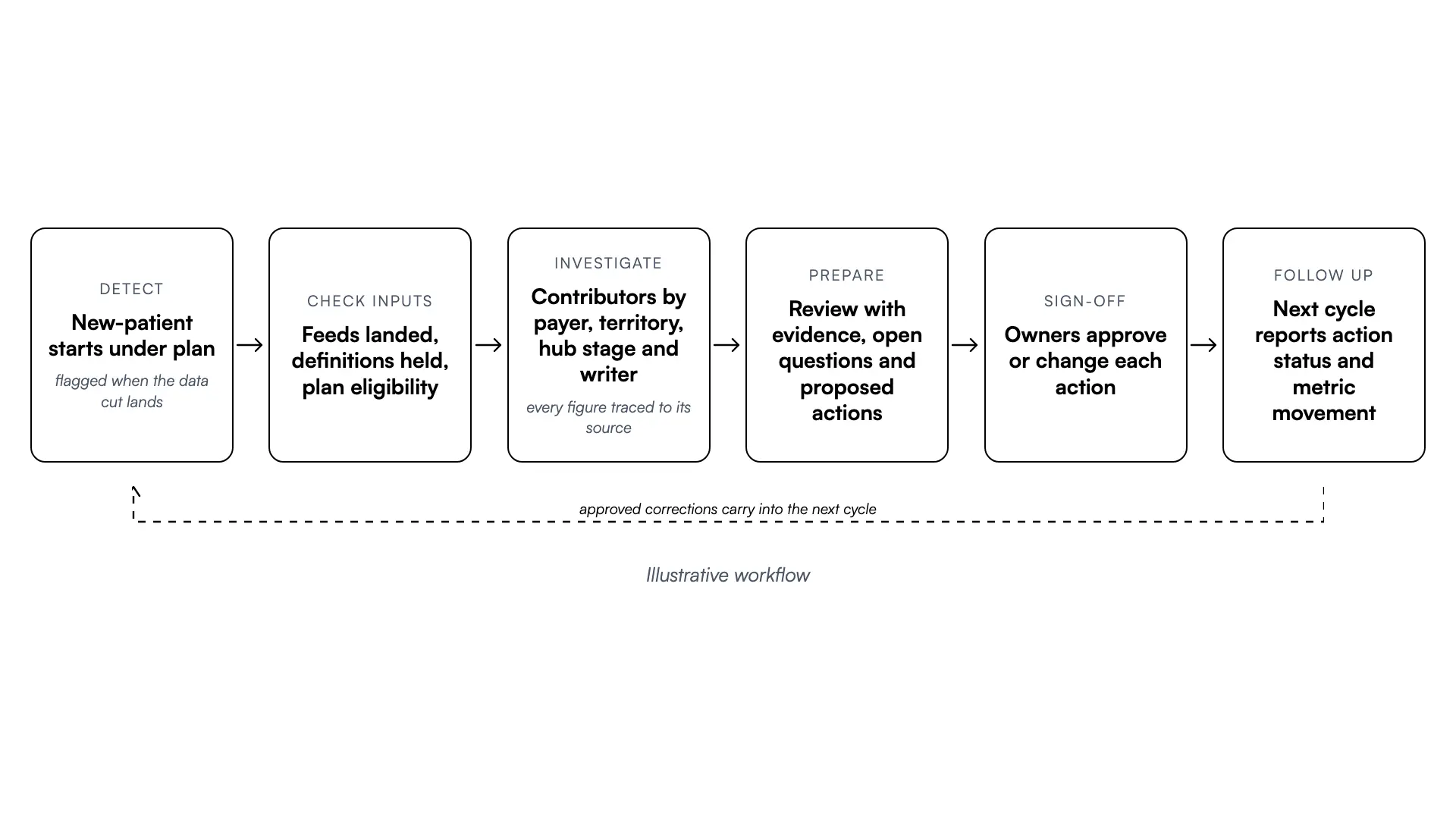
- Detect: each new data cut is checked against plan, and a shift in NBRx, new-patient starts, PA approvals, abandonment or hub flow raises a flag when it lands
- Investigate: the AI worker checks its inputs first, then breaks the gap into contributors by payer, territory, specialty, hub stage and writer segment
- Prepare: the review is drafted with the evidence behind each contributor, the questions the data can't settle, and proposed actions with an owner for each
- Follow up: the next review reports each approved action's status and how the metric moved, without assuming the action caused it
Where Tellius excels: the brand team runs and extends the investigation itself, on shared definitions where any figure opens to the query and source behind it. Approved corrections carry into the next run, and a new question becomes an App or a scheduled Mission without a services request.
Where Tellius falls short: it doesn't own data, so syndicated Rx, claims, SP, hub and payer feeds have to be licensed from IQVIA, Symphony, Komodo Health or others and connected before approval to read the first weeks. It doesn't build forecasts, launch plans, a payer value story or a price, and it doesn't deploy reps, field reimbursement managers (FRMs) or a hub. Medical affairs, medical science liaison (MSL) and HEOR teams sit outside its focus.
What to verify: which of your feeds connect live and which need loading, how long the first launch review takes to configure once feeds and definitions are ready, and which external systems and operations are supported for approved actions in your environment.
Pricing: SaaS subscription, custom quote. See Pricing.
Consider if you want the recurring launch work to run on your own data, owned and extended by your own team, alongside whichever strategy or execution partner you hire. The pharma launch analytics platforms comparison covers the software side in more depth.
ZoomRx: research-led launch tracking
ZoomRx offers a Launch Excellence solution built on primary research: pre-launch market assessment, HCP message testing, awareness and promotion tracking, chart audits, and AI tools for synthesizing launch signals.
Where ZoomRx excels: it shows how HCPs perceive the brand and its message, often the first explanation for slow adoption.
Where ZoomRx falls short: survey and chart data don't explain a PA or hub bottleneck, which needs claims, hub and payer data joined at the territory level, and ZoomRx doesn't act in the field or run patient services.
Consider if HCP reception of the launch message is the open question.
Others we considered
Snowflake, a Tellius partner, is where many launch teams land syndicated, claims, hub and CRM data, and Tellius runs on that data where it sits. It's the foundation for the work, not a launch excellence partner. General-purpose AI assistants such as Claude and ChatGPT draft plans, summarize payer policies and analyze exported data, but they don't ship pharma launch definitions, licensed feed connections or scheduled launch reviews.
What does a recurring launch investigation look like in Tellius?
An AI worker detects a shift, investigates it across the licensed feeds, prepares the review with its evidence and open questions, and follows up on approved actions the next cycle.
The AI workers, root-cause analysis, scheduled Missions, Apps and figure-level provenance ship in the platform (Tellius 6.4 release). Connecting each licensed feed and defining the brand's launch KPIs are set up for each customer, usually with Tellius during onboarding. The example below is illustrative.
Shared definitions hold the loop together: NBRx, total prescriptions (TRx), abandonment, PA approval, time to therapy, and hub and SP statuses are defined once and used in every review. Any figure opens to its provenance, whether matched from the data, calculated or derived, with the query and source behind it. When someone approves a correction, such as a plan reclassified or a definition tightened, it becomes part of the next run instead of a note in a deck.
Actions follow three separate steps. Tellius prepares a proposed action, delivers it to the person who owns it, and, where a connection to another system is set up, shows the exact change for approval before anything runs. The systems and operations supported in your environment are confirmed with Tellius during scoping. People make the decisions, and the AI workers prepare the work.
A worked example (illustrative). In this illustrative case, new-patient starts are 11% under plan in week 9, concentrated in one region.
- Input checks: the syndicated Rx, hub and SP cuts all landed, plan values match the approved forecast, and three territories are excluded from plan eligibility because their reps started after launch.
- Observed contributors: PA denials at two regional plans account for 42% of the illustrative gap, hub cases stalled at benefits verification for 28%, slower SP dispensing for 18%, and narrower writer breadth for 12%.
- Evidence: PA denial rates by plan from claims, case timestamps from the hub, dispense intervals from the SP feed, and writer counts from syndicated Rx, each linked to the query that produced it.
- Open questions: whether the two plans changed PA criteria or applied existing criteria more strictly, which claims data can't settle, and whether the hub backlog reflects staffing or a form change.
- Proposed actions with owners: FRM outreach to offices covered by the two plans (field leadership), an escalation on the benefits-verification queue (patient services), and a payer-policy check (market access).
- Sign-off: the brand lead approves all three and has the FRM outreach start with the larger plan.
- Next review: week 10 reports each action's status, the PA approval rate at both plans and the hub queue length. If starts recover, the review records that alongside the actions without claiming one caused the other, and the open questions stay open until evidence closes them.
The same loop serves each role. Brand leads get the launch review. Market access gets a payer investigation when coverage or PA criteria shift, with the effect on patient starts quantified. Field leadership gets territory and pre-call briefs. When a team needs something new, it describes a tracker and gets an App whose steps it can inspect, or turns a recurring question into a Mission it schedules and edits itself.
The closest public proof comes from field analytics rather than a launch. At Novo Nordisk, a weekly field review that took 8 to 10 days of manual work now reaches insight in 2, with 88% time savings and adoption across 11 field teams plus the home office (Novo Nordisk customer story). The mechanism is the same: a recurring review that runs on a schedule and arrives prepared.
Bring one launch question to your own data. Once your feeds and definitions are connected, bring last month's starts gap to a working session and an AI worker will investigate it, with every figure traced to its source. Book a working session
Which pharma launch excellence partner fits your team and launch?
Start with what the launch is missing. For most teams the answer is a services partner for capacity plus recurring launch work the brand team owns.
Tellius vs IQVIA for pharma launch excellence: who runs the recurring investigation?
IQVIA supplies the data, the strategy, the field capacity and an agent platform built around its own data. Tellius gives the brand team its own investigation across IQVIA's data and every other feed it licenses.
Both now put AI agents to work on commercial questions. The difference is whose data the agents start from and who runs the investigation each cycle.
The documented difference is scope. IQVIA's agents start from data IQVIA owns and come with strategy and field capacity. Tellius starts from every feed the team licenses and gives the recurring work to the brand team. The two can run together, with IQVIA data flowing into Tellius.
Tellius vs ZS for pharma launch excellence: implementation and ongoing control
ZS combines launch expertise, professional services and the ZAIDYN platform. Tellius focuses on letting the brand team turn a business question into an inspectable App, a recurring Mission and an approved follow-up, then change all three itself.
Both leave an agentic platform in place after a project, and because ZAIDYN comes as self-serve products as well as through professional services, not every question goes back to a consultant. What ZAIDYN's public materials don't establish is how independently a customer extends an implemented application to a new business question, which is the work Tellius is built around.
The table holds both to the same assignment: a brand team wants a launch review it runs, changes and extends through the first launch year.
ZS has a launch strategy practice and the services to build the first version, which a team without analytics staff needs. Tellius documents customer-run creation and change of recurring workflows with figure-level provenance. How ZAIDYN's self-serve model handles the five workflow tasks in practice stays unverified until a demo with your own users. Some teams use both, with ZS on strategy and Tellius on the recurring reviews, but for a team choosing one platform to own that work, the deciding question is who makes the next change and what it costs.
Tellius vs Axtria for pharma launch excellence: launch diagnosis or launch operations?
Axtria runs the operational machinery of a launch on software and services. Tellius investigates why launch performance moved and prepares the recurring reviews.
Both sell software a team licenses, which makes them the closest pair in this guide, but they point it at different jobs. The Tellius vs Axtria comparison goes deeper on the platform side.
Tellius fits when the open problem is explaining launch performance fast enough to act on it. Axtria fits when data management, territories, alignments and IC are the gaps in the launch plan.
What should a pharma launch excellence partner show you in a demo?
Ask every partner to work a real launch problem on screen, because a framework slide says little about how the next off-plan week will go.
- Show last month's starts gap in covered territories, broken down by payer and writer segment, with each figure traced to its query and source rows.
- When PA approvals drop at one regional plan, who prepares the response for the field and access teams, and how long does it take?
- Which of our feeds (syndicated Rx, claims, SP, hub, payer files, CRM) join in one view before the PDUFA date, and which need a separate integration project?
- What happens to the launch review if our engagement or contract ends after month six, and is a new launch question covered by what we already pay?
- Which parts of the launch work does our own team run without your staff, using the same NBRx, abandonment and time-to-therapy definitions across brand, access and field?
- How does a proposed action reach a rep or an FRM, who approves it, and what gets changed in which system afterward?
Key pharma launch excellence terms
- NBRx (new-to-brand prescriptions): the earliest read on adoption.
- TRx (total prescriptions): new prescriptions plus refills.
- New-patient starts: patients beginning therapy, often tracked through hub and SP data.
- PA (prior authorization): the payer approval step that holds a covered prescription until it's cleared.
- Abandonment: prescriptions written but never dispensed or started.
- SP (specialty pharmacy): the pharmacy channel for many specialty and rare disease launches.
- Hub: the patient-services program that handles benefits verification, PA support and onboarding.
- Pull-through: turning payer coverage into prescriptions through field and access work.
- PDUFA date: the FDA action date under the Prescription Drug User Fee Act that anchors the launch timeline.
- FRM (field reimbursement manager): the field role that helps offices work through access and reimbursement.
Pharma launch excellence partners: Frequently Asked Questions
Which partners are best for pharma launch excellence in 2026?
It depends on the job. For launch strategy and forecasting, ZS, IQVIA, Trinity and Acumetis have the deepest documented practices. For execution capacity, EVERSANA, Syneos Health, Inizio and IQVIA supply field teams, hubs and patient services. For managing launch performance continuously on the brand's own data, Tellius is built for that work.
Which launch excellence partners give teams AI analytics they run themselves?
Tellius, Axtria, Veeva, Komodo Health and ODAIA all sell software a team licenses and runs, and ZS offers ZAIDYN as self-serve products. Tellius is the one built around AI workers and scheduled launch reviews that the brand team creates and edits itself.
Which firms offer launch strategy and field deployment together?
IQVIA, EVERSANA, Syneos Health and Inizio combine launch strategy or advisory with contract field teams. EVERSANA, Syneos Health and Inizio also run hub or patient support services.
Which pharmaceutical launch services fit an emerging biotech's first launch?
A first launch with no commercial organization usually starts with EVERSANA, Syneos Health or Inizio for field, hub and access capacity. Axtria and ZS offer packages built for emerging pharma. Once the biotech's licensed feeds are connected, Tellius can run the launch reviews from the first data cut.
Which launch excellence firms cover market access and patient services?
EVERSANA and Inizio operate hub and patient access services, Syneos Health runs patient support, and Acumetis and Trinity design access strategy and patient programs. Tellius doesn't run patient services, but it investigates coverage and PA shifts by plan and ties them to patient starts. The pharma market access analytics comparison covers the software side.
EVERSANA vs Syneos Health: which fits a full-service launch?
EVERSANA covers advisory, pricing, field, hub and 3PL under one contract. Syneos Health pairs field and patient-support capacity with clinical research and a causal AI platform built around HCP engagement. Choose on which services you need under one contract and on regional coverage.
Veeva or Komodo Health: which fits launch data and field planning?
Veeva fits when field execution and targeting run in Vault CRM with Compass data. Komodo Health fits when patient-level claims are needed to find a narrow launch population and the HCPs treating it. Many launches use both.
How does Deloitte compare to pharma launch specialists?
Deloitte brings broader strategy and systems integration, and fits when the launch needs new CRM and data infrastructure built by the same firm that set the strategy. Specialists such as ZS, Trinity and Acumetis bring launch-specific methods and benchmarks.
Can Tellius replace a launch consultancy?
Partly. Tellius takes over the recurring analytical work that often sits inside a launch engagement: the investigation, the launch reviews, and the payer and territory briefs. It doesn't replace launch strategy, forecasting, pricing or field and hub capacity, so it's usually paired with a strategy or execution partner. Agreeing on shared KPI definitions at the start keeps the two from disagreeing.
What do pharma launch excellence services cost?
None of the services partners publish prices. Consulting is engagement-based, field and hub services are contracted by scope, and data is licensed by subscription. Software platforms, Tellius included, quote subscriptions. Over a launch's life, the larger cost driver is how many new questions need new scope.
How far before the PDUFA date should a launch partner start?
Strategy partners usually start during late-stage development, since forecasts, the value story and readiness plans take time. Analytics needs the syndicated Rx, claims, SP and hub feeds licensed and connected before approval, so the first data cuts can be read when they land.
What should you look for in AI launch analytics software?
Four checks apply to any tool. Does it rank the contributors behind a starts gap across every feed you license? Does every figure trace to its query and source rows? Does the launch review run on a schedule and arrive prepared without a new request? And does every proposed action wait for a named person's approval, with a clear line between preparing an action, delivering it to its owner and changing a system? Tellius is built around those checks, and the brand team still decides what to do.
Keep the recurring launch work with your team
Your strategy partner sets the plan and your execution partner staffs the launch. Tellius gives the brand team its own investigation of why NBRx, new-patient starts and PA approvals moved, every cycle, without a new scope. Start with a walkthrough on sample data, then bring one launch question to a working session once your feeds and definitions are connected.
Get release updates delivered straight to your inbox.
No spam—we hate it as much as you do!


AI Agents for Pharma Commercial Teams: The 2026 Field Guide to Use Cases, Vendors, and What's Actually Real

This field guide examines the AI agent use cases that are actually being deployed across brand analytics, field sales, market access, forecasting, omnichannel engagement, incentive compensation, and commercial operations. The guide compares leading vendors and deployment approaches, highlighting the differences between AI copilots, agent frameworks, agentic analytics platforms, and purpose-built commercial AI solutions.
.webp)
Best Pharma Launch Analytics Platforms in 2026: What Each One Does Best
Launching a new therapy has never been more data-intensive—or more complex. Commercial teams must coordinate brand strategy, field execution, HCP engagement, market access, patient adoption, omnichannel performance, and competitive intelligence while making decisions in near real time. This buyer's guide compares the leading pharma launch analytics platforms in 2026, evaluating what each solution does best across launch planning, forecasting, HCP targeting, territory performance, market access analytics, omnichannel measurement, patient journey insights, and AI-powered commercial intelligence.
.webp)
Best AI Platforms for Pharma Commercial Analytics in 2026: 11 Platforms Compared
This guide compares the 11 best AI platforms for pharma commercial analytics in 2026, evaluating how each supports brand performance, market access, patient analytics, field force effectiveness, incentive compensation, and omnichannel engagement. It highlights a key shift in the market: traditional BI and SFE tools focus on reporting what happened, while newer AI platforms differentiate by investigating why performance changed. The post breaks down core capabilities like root cause analysis, data integration, governance, and agentic workflows—helping pharma teams identify which platforms can deliver faster, more actionable insights across commercial operations.