
Give it a goal. It’s always on, learns how your business runs, works with your people to get what it needs and comes back with finished work
 Slack#kelvarna-brand
Kelvarna NBRx fell 6.2% week over week in the Northeast. 4.4 points trace to one payer, Brindlemoor Health. The breakdown is ready.
@Brand AI teammate is this access or execution? Build the review for Monday's meeting.
On it. Pulling claims, payer coverage and CRM. The review lands in this channel by 08:00.
1,284
−4.4 pts
−1.1 pts
−0.7 pts
1,204
claims_weeklycoverage_feedcontribution()crm_callsclassify_gaptie_outBrand_template.potx PowerPointKelvarna_Northeast_Review.pptxPosted to #kelvarna-brand · 07:58

Hartwell is 11% behind target. 7 points are access: Brindlemoor's Tier 3 change hits 22 of its top 40 prescribers. 4 points are execution: 9 high-volume prescribers haven't had a call in 6 weeks.
 OutlookSent · 06:04
Each of you has a territory plan attached. Hartwell and Ostrell need the PA support kit this week. Corvane and Pellow should rebalance calls toward the prescribers listed on page 2.
 Hartwell_plan.docx+11 territory plans
11% behind target. 7 points access, 4 points execution.
2 · Who to see firstDr. A. Okafor, Dr. L. Brennan, Dr. S. Iyer, then 6 more ranked by scripts at risk.
3 · What to bringPA support kit for Brindlemoor patients. Tier 3 savings card.





AI helps with tasks.Yet recurring jobs pile up on you.
ChatGPT, Claude and AI tool copilots can answer one-off questions. But messier work (think: field reviews, payer QBRs, month-end commentary) still requires manual stitchwork, deep context, and chasing down people.

The number moves Tuesday, someone notices Friday, and the analysis lands after the window closes.

Every session needs the context retyped: what NBRx means here, which payers matter, who signs off.

The variance math was never the slow part. Chasing five budget owners still lands on you.
24/7 AI teammates with domain knowledge baked in to get messy work done

Goal-oriented
Give it a function or goal, like keeping a launch on track. It plans the work, proposes what to take on and sees it through.

Proactive, Always on
It watches your data around the clock and brings you the work before you ask: the payer change the day it posts, the review before the meeting.

Domain expertise baked in
It knows your team's function, from NBRx and formulary tiers to variance drivers and trade lift. Then it gathers your definitions, rules and approvers on its own.
Give it a goal. It automatically gathers context and gets to work
Give it a goal, like keeping the Northeast launch on track. It gathers your data, definitions and approvers, proposes the tasks to take on, then works around the clock and only interrupts you for decisions.
AI teammates work with your team and each other
Put an AI teammate on each function. Each owns its own goal, and they share one business context. Kaiya, the 24/7 AI orchestrator, coordinates worker AI agents behind them, and your people make the calls.
Northeast review posted · 2 fixes assigned to owners
Brindlemoor Tier 3 change shared with the Brand AI teammate
$0.9M timing · $0.6M FX · $0.3M operating
Rep notes drafted for 3 district managers
AI teammates work where you do
The work comes to you, in the tools you already use: Teams, Slack, in the systems of record, your phone, or through your favorite AI chat app via MCP.
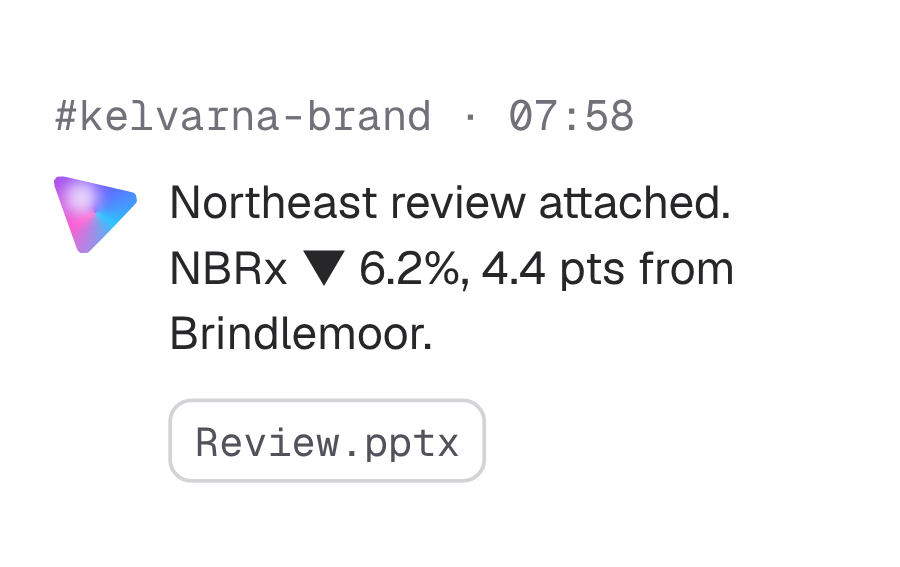
Slack, Teams and email
The finished review lands in the channel, chat or inbox your team already reads.
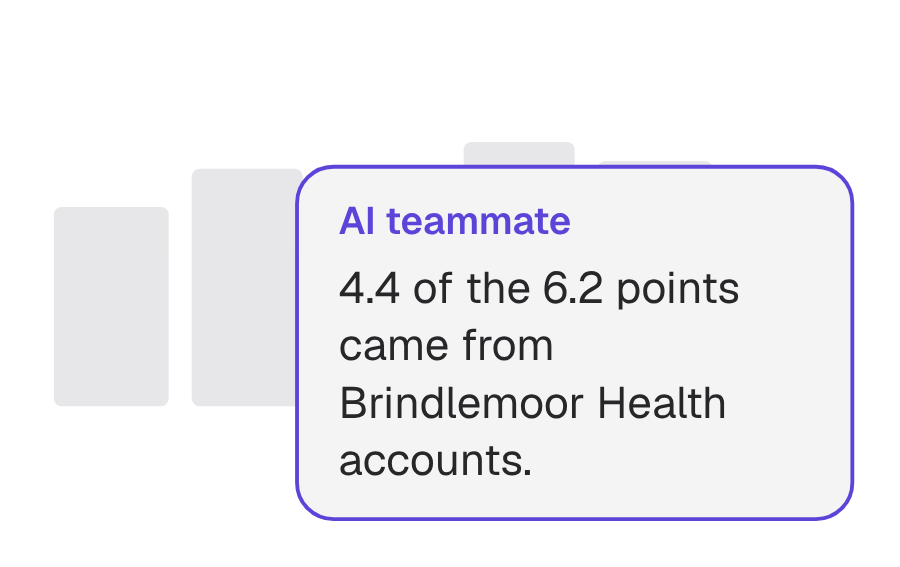
On top of your dashboards
Your AI teammate sits over the dashboards you already run and explains what changed and why, without a rebuild.
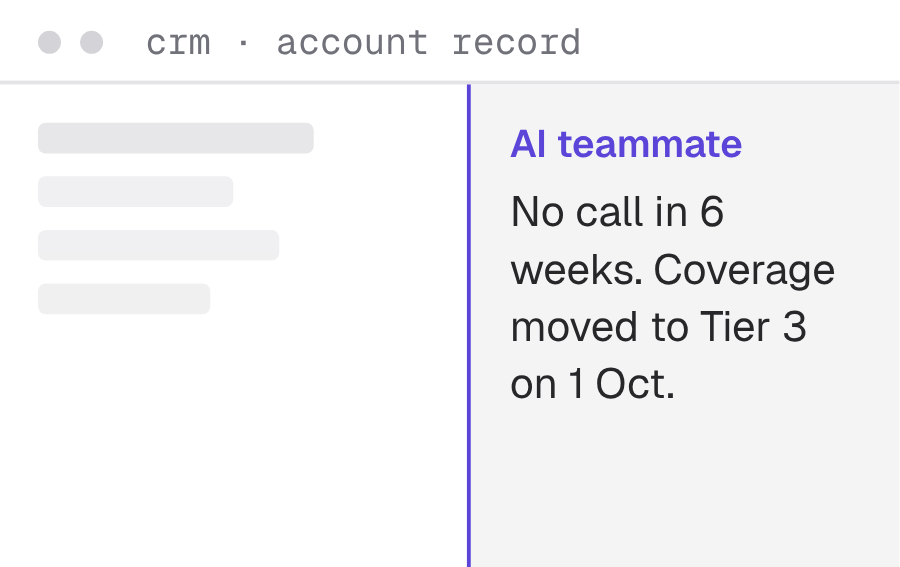
Inside your systems of record
The browser extension brings the AI teammate's context into your CRM or ERP, next to the record you're working.
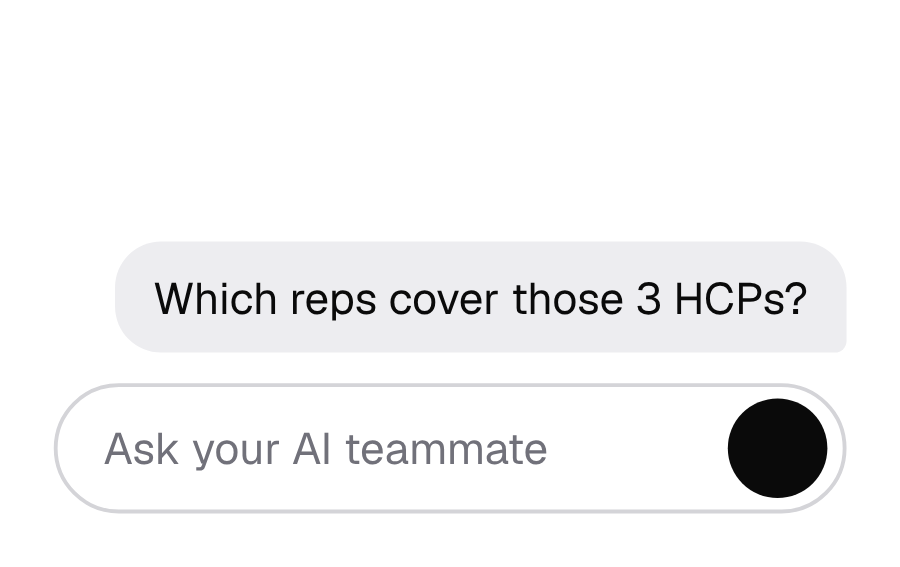
The Tellius platform
Brief an AI teammate, approve its plan, correct it and ask follow-ups in one place.
Mobile
Read the review between meetings and reply with a follow-up.
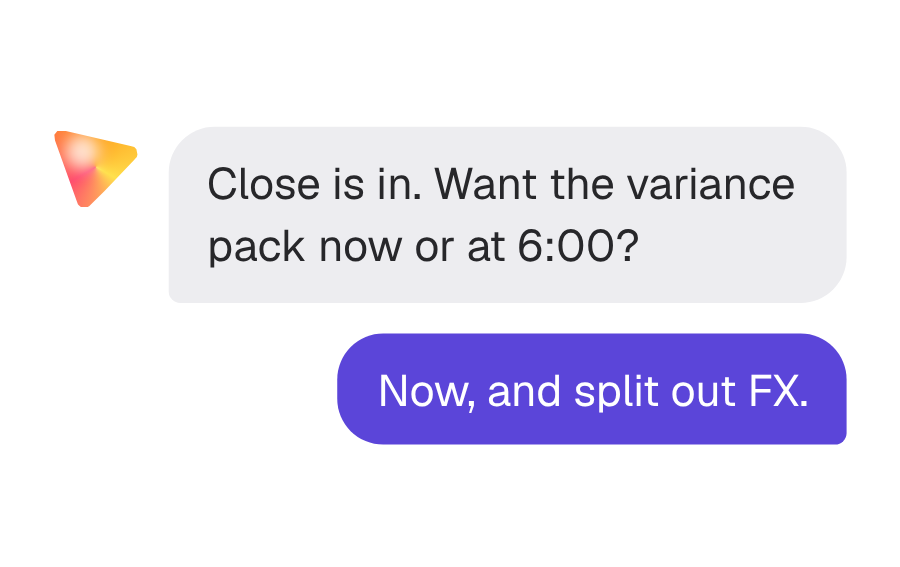
Chat with your AI teammate
Message it the way you'd message an analyst on your team, and it answers in the thread.
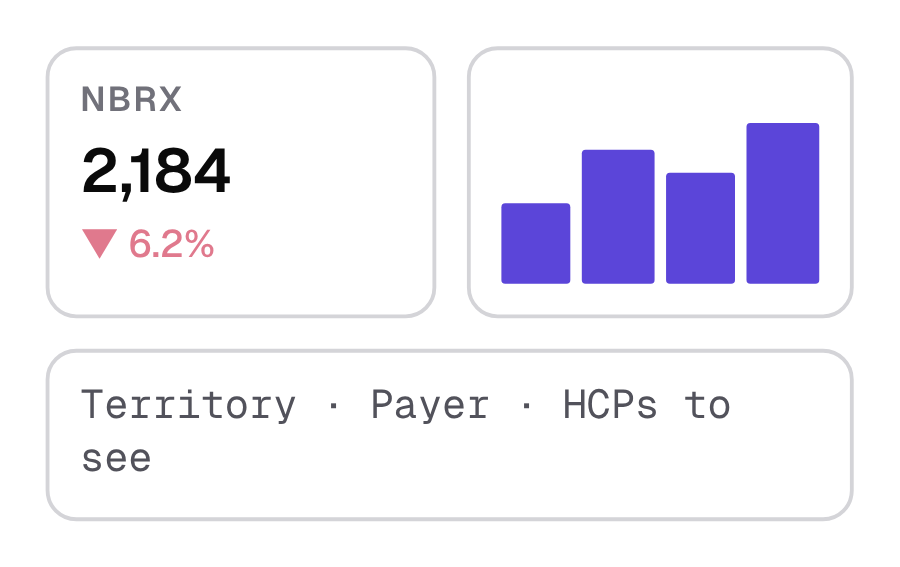
Agentic Apps
Describe the app you want and it's built on live data, so the team opens the AI teammate's work every day.
Finished deliverables
PowerPoint, PDF and Word files in your template, ready to present without another pass.
Knows your function, learns your business
Tellius starts with your function's know-how built in, such as NBRx, gross-to-net and payer access, then gathers your definitions, rules and approvers on its own. Numbers are checked against the reports you trust, and every figure traces to the rows behind it.
AI teammates come with curated domain skills and industry-specific metrics, agentic workflows, and applications. They gather the rest on their own, including your definitions.
Approve an AI teammate’s plan once. It’s locked and replayed every run, so the same inputs produce the same numbers. The narrative wording can vary; the figures don’t.
Contribution math splits a metric change into its drivers at any grain and ranks them by how much each one moved the total.
Before a business view goes live, Kaiya Architect checks it for double counting, fan and chasm traps and unexpected row-count changes. The query planner checks grain again at run time.
The numbers that fail to tie are usually the ones that span two systems. AI teammates join claims, CRM, payer coverage and the GL on one set of definitions.
Correct a definition once and the rule’s owner approves it. Save it for yourself, a data model or the whole company. Company rules override personal preferences, and nothing is saved without confirmation.
Hover any figure for its source, its row and column counts, and the full SQL and Python. Nobody rebuilds it in Excel to check.
- NBRx, TRx and share of class
- Gross-to-net
- Payer access and formulary tiers
- HCP targeting and call reach
- Price, volume and mix


FROM bv_kelvarna_claims
WHERE week_start >= '2026-10-20'
AND channel <> '340B'
GROUP BY territory


 AppsMobile appYour dashboards




 Your LLM gateway































AI teammates for every function
Goal: keep the launch on track. It watches NBRx, share and payer coverage every day, explains what moved before Monday’s meeting, assigns the two fixes to their owners and checks Friday whether they worked.
Goal: every district on plan. It separates access gaps from execution gaps by district, drafts notes to the reps who haven’t seen the most exposed offices for the manager’s OK, and sends each manager a plan for the week.
Goal: no coverage change goes unnoticed. It reads payer policies as they post, resolves the findings where sources agree, models the patient impact and sends the rest to the access lead with the evidence attached.
Goal: every variance explained by Thursday. It splits the month’s gap into timing, FX and operating drivers, asks each line-item owner for the reason, follows up with the ones who haven’t replied and drafts the report with recommended actions.
Goal: fund the promotions that pay. It measures each event against baseline, separates true lift from pull-forward and brings the category team a repeat, cut or reprice call before the next planning cycle.
Goal: keep this quarter’s forecast on track. Every Monday it checks forecast deals across Salesforce, Gong and email, asks the owners of slipping deals for an update in Slack, drafts next steps for the manager’s OK and checks whether those deals moved.
Goal: less scrap on every line. It tracks scrap, yield and downtime by line, finds which shift, material lot or changeover drove yesterday’s change and has it in the shift lead’s inbox before the meeting.
Goal: stop off-contract spend the week it happens. It flags off-contract spend weekly by supplier, drafts the note to the buyer who placed it and the supplier follow-up, and tracks the response.
See an AI teammate prepare the quarterly access review

Access analytics lead
Quarterly access review
1:36

Market access analyst
Payer policy change
1:16

District manager
Weekly NBRx briefing
1:27

Head of FP&A
Month-end variance review
1:24

10 days → 2
Novo Nordisk

12x faster root cause
PepsiCo

20 hrs → 30 min
Pelmorex
How it works
AI teammates run flexibly on your warehouse, definitions, LLMs, the tools your team already uses.
Connect
Your warehouse and systems, as they are

Connect your warehouse, CRM, ERP and syndicated data where they live
Add the plans, contracts and call notes that sit in files
Nothing in your existing pipelines has to change
Inherit
Definitions, access and model, reused
Import the definitions you already maintain, from Snowflake Cortex semantic models or dbt
Every surface inherits each person's existing permissions
Run on the AI model your company already approved
Deliver
Where your team already works
Post finished reviews to the channels and inboxes your team already reads
Bring your AI teammate over your existing dashboards and into your CRM or ERP
Build decks and documents in your own template
FAQs
An assistant answers the question you type. An AI teammate takes a function or a goal, finds the recurring work, proposes what to take on and follows up with the people involved. It only interrupts you for decisions, and nothing goes out without your OK.
Teams whose recurring work spans data, systems and people: brand, field sales and market access in pharma, FP&A, revenue management, procurement and RevOps. Each AI teammate comes with know-how for its function, such as NBRx, gross-to-net and trade promotion.
Yes. An AI teammate's plan is locked when you approve it and replayed every run, so the same inputs produce the same figures and the same drivers. The wording of the narrative can vary slightly from run to run.
Those tools are good at answering a question or running a task when you ask. A Tellius AI teammate starts before anyone asks, knows your function's metrics and your team's rules, and does the follow-up with people: gathering inputs, drafting what goes out for your OK and closing the loop.
Yes. AI teammates run on your warehouse and your existing definitions: Snowflake Cortex semantic models and dbt models import directly. They work with OpenAI, Azure OpenAI, Gemini, Vertex AI and Snowflake Cortex, and with your own LLM gateway.
Wherever you already work: Slack, Microsoft Teams or email; on top of your existing dashboards; inside your CRM or ERP through the browser extension; on mobile; or in an App. You brief, approve and correct it in the Tellius platform.
About two weeks for the first job. In week one we learn how your team does it today. In week two we configure the AI teammate on your data and prove it against the last version your team approved.
Yes, at the scope you choose. The owner of a rule approves a correction before it is reused, for one person, for everyone using a data model, or for the whole deployment.
Yes. Each AI teammate owns its own goal and hands specialist work to specialist AI agents, either ready-made ones such as Month-End Variance and Payer Policy or ones your team creates. Kaiya, the 24/7 AI orchestrator, coordinates them. Because AI teammates share one business context, a coverage change one of them catches can feed another one's review.
AI teammates inherit the same permissions as the people who use them, on every surface, and read metrics through your governed semantic layer.

Meet your AI teammate
Show us one job your team repeats. Your AI teammate takes it from there.