

AI Agents for Data Analysis: What Data Teams Need From Agentic AI

An AI agent for data analysis takes a question, plans the steps to answer it, runs the queries against your warehouse, and hands back a brief with the root cause and the drivers behind it. It's one piece of agentic analytics (what is agentic analytics).
Building one isn't the hard part anymore. A data team that knows its warehouse can get a demo working without much trouble, and a lot of companies are choosing to build. In McKinsey's State of AI 2026, "Nearly a third of respondents (32 percent) report that their organizations have decided against buying one or more software products or features because they could be built internally with agentic coding tools."
The hard part is production. A demo answers the question it was shown. An agent the business relies on has to run the same SQL every week, trace each figure to the query behind it, keep only the corrections a person saves, respect the permissions your warehouse already enforces, and wait for a person to approve anything it writes. Miss one of those and the data team ends up working a queue of "why did the number change?" tickets.
What an AI agent for data analysis does
An AI agent for data analysis does the investigation an analyst would otherwise piece together by hand, and returns the result as a brief. Say revenue in one region dropped last month. The agent plans the steps, queries the sources involved (orders in the warehouse, pipeline in the CRM, credits in the finance system), breaks the drop down by product, segment and account, checks that the pieces add back to the total, and writes up the root cause and the drivers behind it.
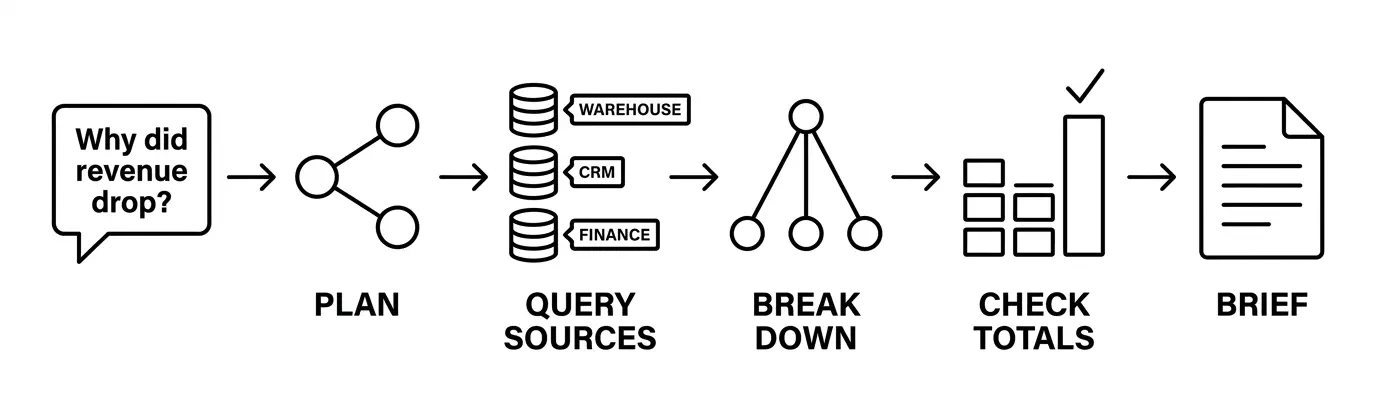
Most of that work is reconciling sources that disagree on keys and definitions, where nobody wrote down which one wins. Only then can the agent explain anything, and the explanation arrives as a brief someone can read and forward. Some agents also add a recommended next step. That only makes sense once a team has written down how it decides, so treat it as something you set up on purpose rather than something you get by default.
How an AI agent differs from a chat interface on your warehouse
A chat interface on your warehouse writes new SQL for every question and forgets the conversation when it ends. That works for exploring. It breaks down when the same question has to come back with the same logic every Monday, or when someone asks where a number came from.
Most teams start in the left column and build toward the middle. The production work turns out to be everything the middle column says you have to build yourself.
Data analysis jobs that are ready for AI agents today
The jobs that work today repeat on a schedule, start from a defined input and already have someone who checks the result. Each of these five has all three.
- Metric-change root cause. A KPI moves past its threshold, and the agent returns a brief naming the segments, products or regions behind the change. The metric owner reviews it before it goes anywhere. More on AI root cause analysis.
- The recurring performance brief. Every Monday the week's numbers land in the deck or PDF the business already reads, built from the same SQL as last week. An analyst spot-checks it before it's sent.
- Anomaly triage. When a monitor flags a spike, the agent works out whether the business changed or the data did (a late load, a schema change, a duplicate feed) and hands its findings to the on-call data engineer.
- Cross-source reconciliation. CRM bookings and finance revenue rarely match. The agent lines the two up and shows which records account for the gap, and each system's owner signs off on the fix.
- The ad hoc "why" backlog. Repeat questions in the "why did X drop?" queue get a first-pass answer that the analyst who owns the ticket can check and send.
Why AI agent builds stall after the demo
Gartner expects a lot of agent projects not to make it. In its June 2025 forecast, "Over 40% of agentic AI projects will be canceled by the end of 2027, due to escalating costs, unclear business value or inadequate risk controls."
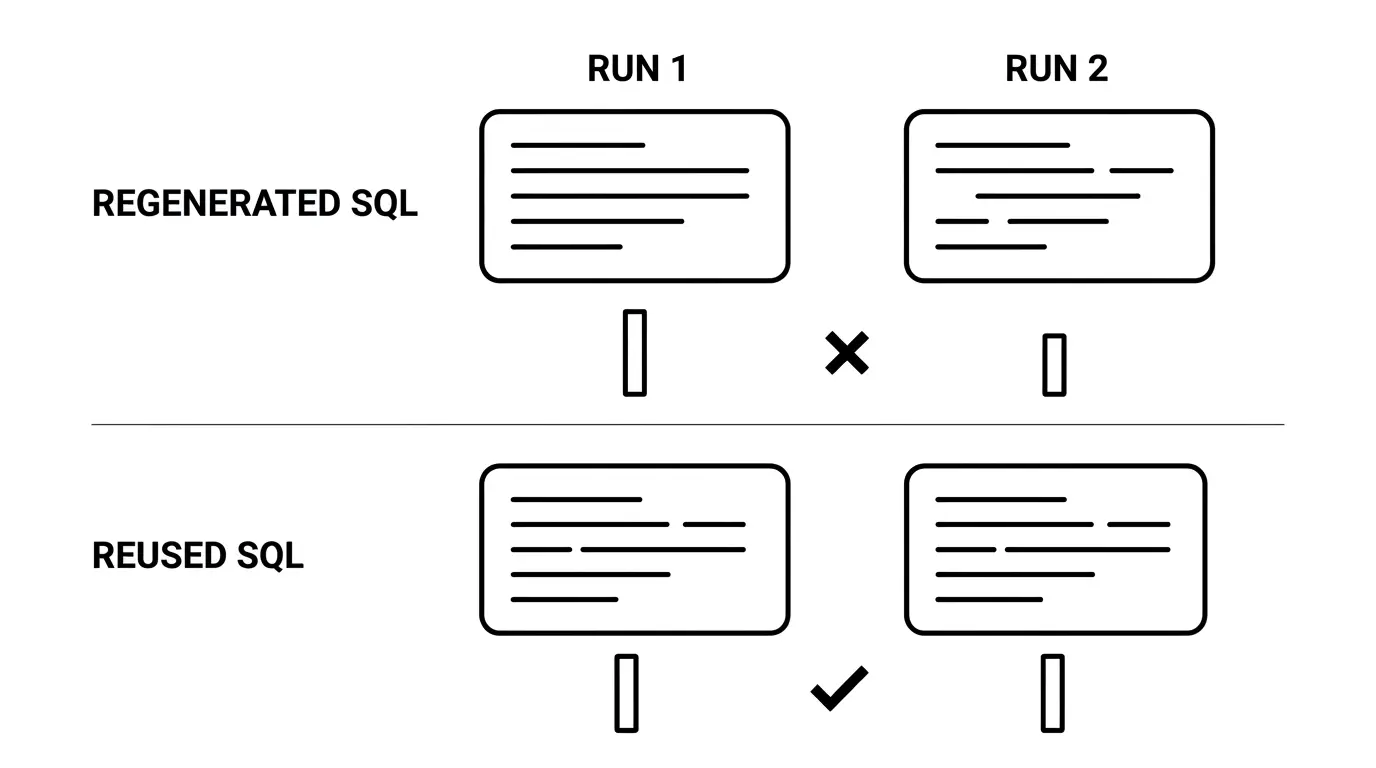
In data analysis, most of the trouble starts with queries that get regenerated on every run. Text-to-SQL writes new SQL from each prompt, so a reworded question or a model update changes a join, and this Monday's number stops matching last Monday's for reasons nobody can see.
Definitions cause the next round. "Active customer" means one thing in the product database and another in the CRM, and an agent with no governed definition uses whichever table it finds first. Corrections don't stick either. The analyst who told it on Tuesday to exclude test accounts finds them back in Thursday's answer. And when a VP asks where a figure came from, there's no query to point to.
Hallucination runs through all of it. A model with a partial view of the schema fills the gaps with a plausible column or join, and a good benchmark score on a clean schema says little about a warehouse with thousands of tables and three definitions of revenue.
Building the AI agent vs. buying what sits under it
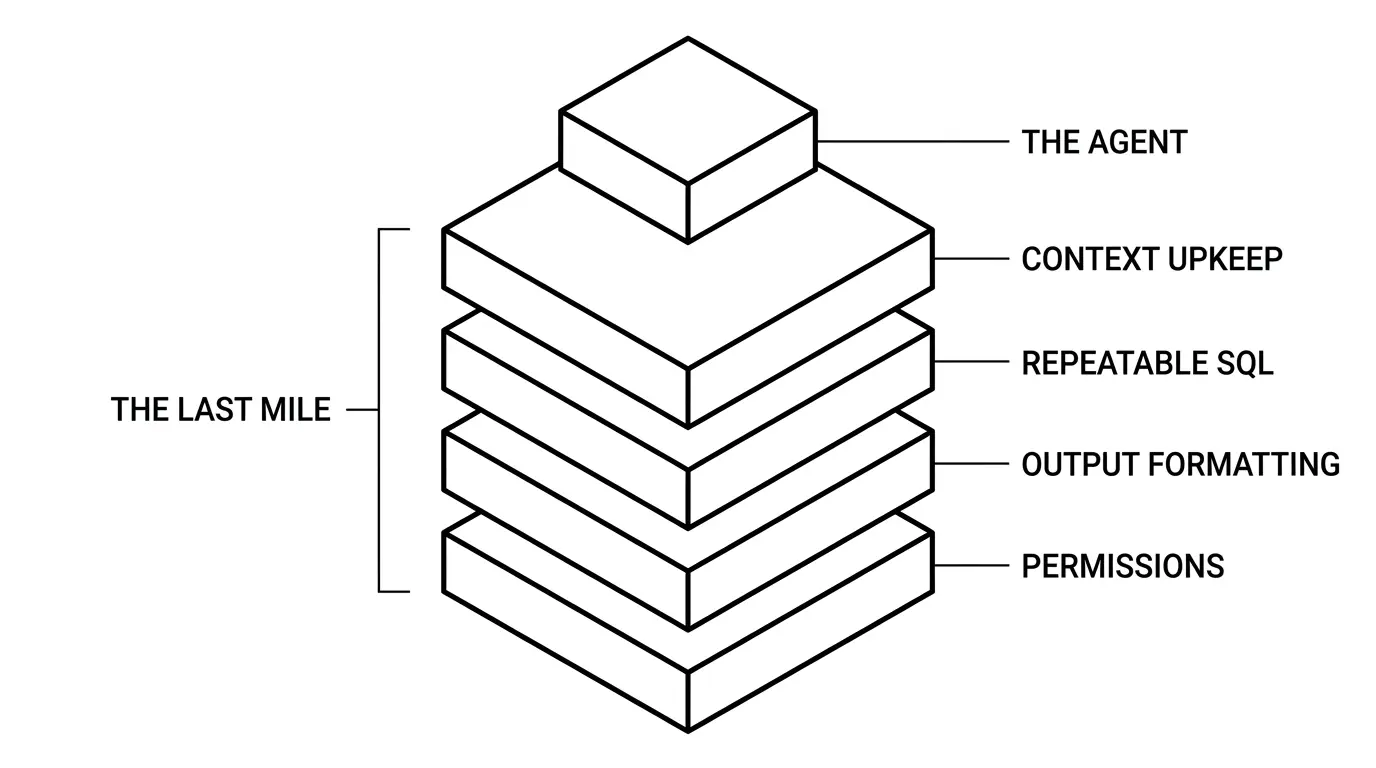
Your team can build the agent, and for a narrow, stable use case that may be the right call. The frameworks work, current models write decent SQL, and nobody knows your warehouse better than you do. The cost shows up in the last mile, and it keeps showing up after launch.
Context upkeep tends to break first. Definitions change, new sources arrive, and each new domain brings metrics that conflict with the last one's, so the prompts and docs that worked for finance start giving wrong answers once sales ops is added. Repeatable SQL is the next job: saving a query per workflow, parameterizing its inputs and versioning it when the logic changes. Output formatting is easy to underestimate, because the business wants the deck it already reads, not a chat log. Permissions are where security reviews tend to stop the project. An agent running under a service account can see more than the person who asked, and any write to another system needs an approval step.
Each of these is manageable on its own. Together they add up to a product your team has to maintain, and the hours come out of the analysis the business asked for. Whichever way you go, reuse the definitions you already have instead of rewriting them into prompts (semantic layer for AI agents).
What an AI agent for data analysis should pass before production
Run these checks on your own build, or on any tool you're evaluating, before its output reaches the business.
Where Tellius fits
Tellius gives data and business teams an AI worker that runs their recurring analysis on governed data and delivers the finished brief. Take the Monday performance brief. Tellius runs it as a scheduled Mission. Before you publish, Preview shows what each step returned and traces every figure to the query behind it, and in a Deep Insight every number links to its source. A Mission's queries are written once, when it's created, and reused on every run, so only the inputs change and this Monday's number comes from the same SQL as last Monday's.
The brief goes out as a PowerPoint, PDF or Word file or by email, and in Slack or Teams. Feed watches the metrics you track for anomalies and the root causes behind them. For one-off questions, Deep Insights works as a conversation and checks the data before it plans. Memory, which replaced Learnings (deprecated in 6.2 and being retired in the 6.4 line), keeps the corrections a person chooses to save.
People decide. When the work ends in another system, Kaiya shows the exact write (operation, destination, rows and identity) and runs it only after a person approves, as that person.
Kaiya can run on models hosted in your own Snowflake account through Cortex inference. Tellius also runs as an MCP server, so agents your team has already built can call it.
Get release updates delivered straight to your inbox.
No spam—we hate it as much as you do!


No. They take the recurring stitching, like pulling sources together, rerunning the weekly numbers and taking the first pass at a "why" ticket. People decide what the analysis means and what the business does about it.
It should. The definitions you already maintain are the cheapest source of truth an agent can read, and an agent that redefines revenue in a prompt will sooner or later disagree with your dashboards. When you evaluate tools, check whether they read your existing definitions or make you rebuild them.
Agentic analytics is the category: AI that plans and runs a multi-step analysis and returns the result for a person to approve. An AI agent for data analysis is the piece a data team builds or buys to do that work on its own warehouse. The full definition is in what is agentic analytics.

The AI Coworker Field Guide: 100+ Deterministic Agentic Use Cases That Grow Revenue, Reduce Risk, and Run Leaner

This field guide features 100 practical AI coworker use cases spanning sales, marketing, finance, supply chain, customer success, operations, IT, HR, and commercial analytics. Rather than focusing on experimental AI, it highlights production-ready workflows where AI agents can automate repetitive work, investigate business questions, monitor key metrics, generate recommendations, and trigger governed actions with predictable outcomes

AI Agent Use Cases for Enterprise Data Teams: 14 You Can Deploy This Quarter
AI agents are quickly moving from experimental tools to practical, high-impact solutions for enterprise data teams—and the biggest opportunity is in deploying them against real, repeatable analytical workflows. This blog outlines 14 high-value AI agent use cases that teams can implement this quarter, spanning areas like automated root cause analysis, anomaly detection, forecasting, pipeline monitoring, and marketing attribution.
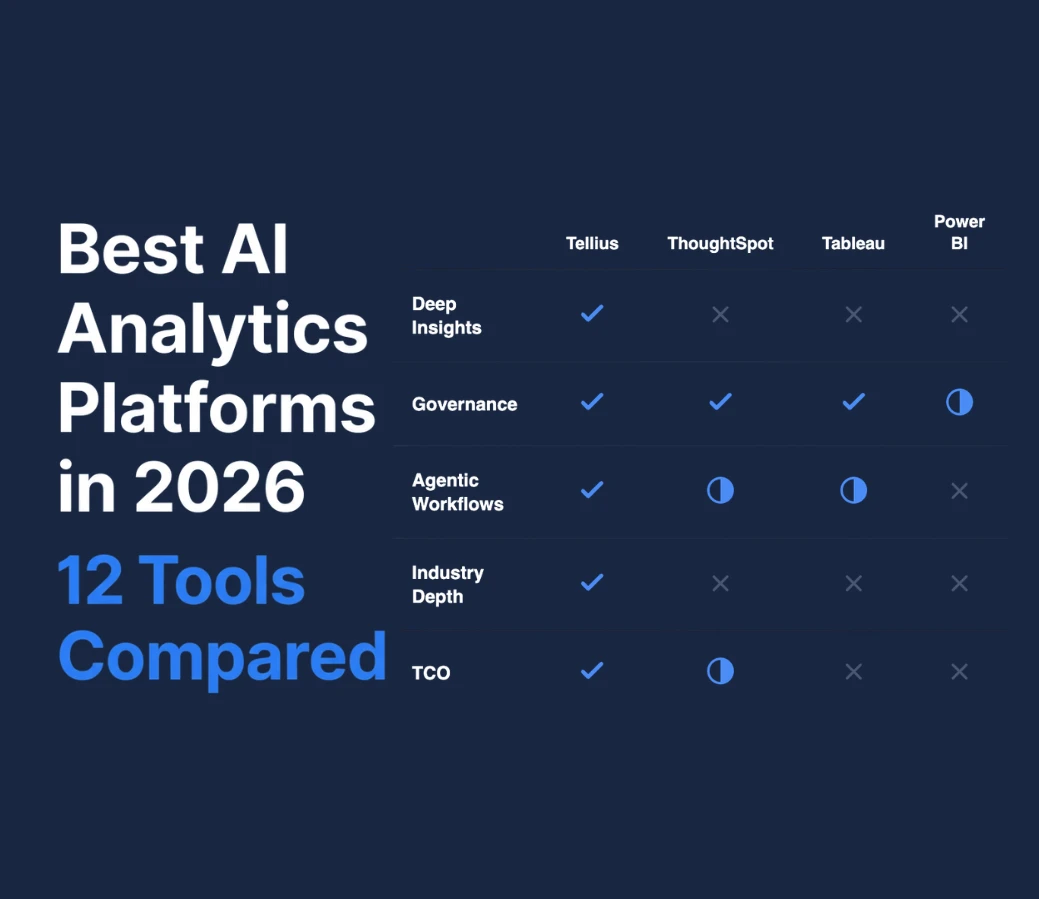
Best AI Analytics Platforms in 2026: 12 Tools Compared for Deep Insights, Governance, and Agentic Capabilities
This guide compares 12 AI analytics platforms in 2026 across the capabilities that actually separate “chat with your warehouse” from real analytical automation: governed conversational analytics, automated deep insights (root cause decomposition + ranked drivers), proactive monitoring, persistent business knowledge and context, industry specificity, agentic workflow orchestration, and total cost of ownership. It explains the maturity ladder from reactive Q&A to always-on agents that detect anomalies, investigate why metrics changed, and deliver executive-ready narratives and recommendations—then profiles where each platform fits (and where “agentic” claims don’t match reality).

How AI Agents Are Finally Delivering on the Promise of Self-Service Analytics
Traditional self-service BI tools promised independence but often left users dependent on analysts and stuck with complex interfaces. AI agents are now transforming the analytics landscape by managing complexity, automating workflows, and reasoning behind the scenes. Paired with a semantic knowledge layer, these agents deliver accurate, business-aware insights. With Tellius, users don’t need to learn analytics—they just ask questions and get answers. True self-service has finally arrived.