

Payer Policy Validation: How to Publish an Access Number That Survives a Challenge

A field rep asks why scripts aren't landing at a payer your access report calls open.
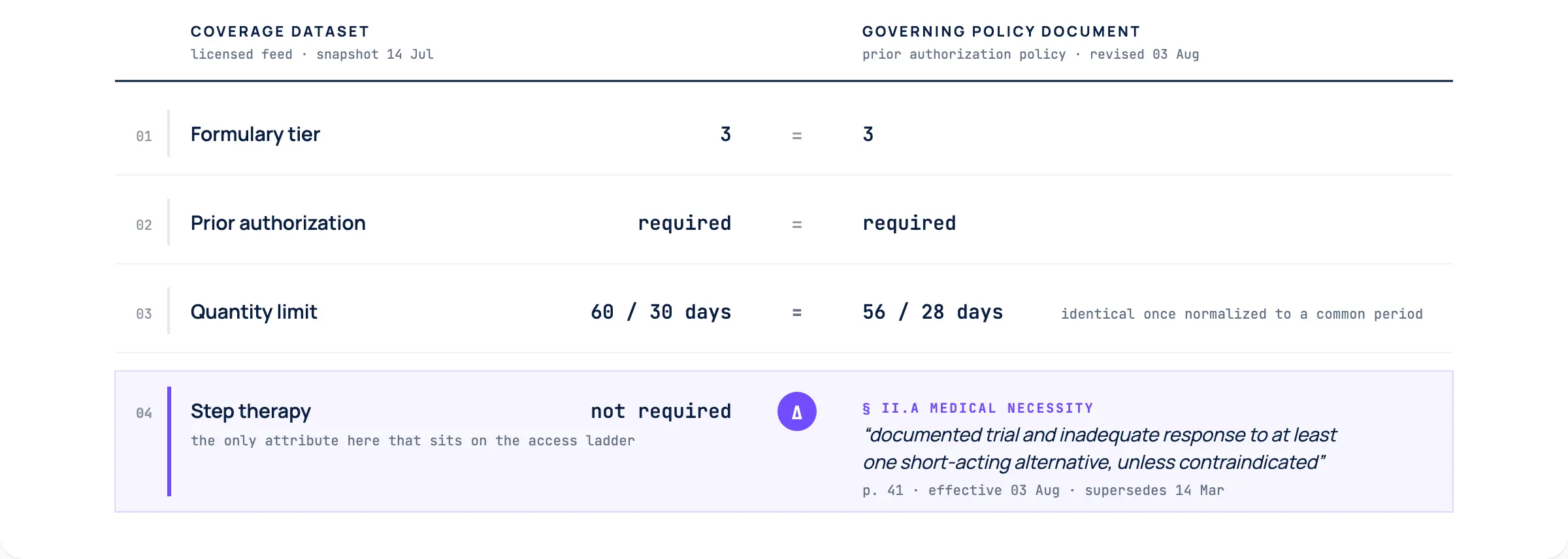
You pull the coverage file. It says tier 3, prior authorization, no step therapy.
Then you open the payer's actual prior authorization policy. Section II.A says the patient must document failure on an alternative therapy first. That is step therapy, written in plain English, in a signed document. Your dataset has no idea.
Payer policy validation is the practice of checking a structured coverage dataset against the payer policy documents that govern access. It measures what any differences do to your published access rates, then routes corrections through human sign-off before they reach reporting.
The gap it closes has a name: coverage drift — the growing disagreement between a licensed coverage dataset that refreshes on a cycle and the payer policy documents currently governing access.
Most market access teams already sense the drift. What is new is that it can now be measured, ranked, and corrected at portfolio scale.
Key findings
- Health plans take a median of 29.7 weeks to update a coverage policy after an FDA label revision, with plan-level medians ranging from 15 to 55 weeks.
- Only 16% of specialty drug-indication pairs are covered the same way by all major US commercial plans.
- 55.6% of step therapy protocols studied across ten diseases were more stringent than the corresponding clinical guidelines.
- Within a single plan, 14% of paired medical-benefit and pharmacy-benefit policies for the same specialty drug and indication had different coverage criteria.
- In the illustrative walkthrough below, extra detail is the largest category of dataset-versus-document disagreement. Counting it as an error makes a healthy dataset look broken.
- In the same walkthrough, most apparent quantity-limit conflicts disappear after the limits are converted to a common time period.
Why coverage drift exists
Coverage drift does not necessarily mean the data vendor failed. Even an accurate dataset begins aging as soon as payer policies move.
A licensed coverage dataset is a snapshot that refreshes on a schedule. Payer policies can change after a P&T committee meeting, a contract renewal, or an FDA label revision. Between refreshes, some records may describe rules that no longer apply.
One national payer may publish dozens of documents for a single product, split by line of business, state subsidiary, benefit type, and formulary version. Across a portfolio, manual review rarely covers enough of the governing documents recently enough to defend a portfolio-wide access rate.
What coverage drift costs
Access rates feed forecasting, gross-to-net assumptions, field targeting, and pull-through planning. An incorrect rate carries the error into each decision.
- Overstated open access sends the field chasing scripts that will bounce off restrictions the data never recorded.
- Understated open access starves open payers of investment and attention.
- A number you cannot trace gets retracted the first time finance or brand challenges it in a forecast review.
The underlying restrictions affect patient care. In the AMA's 2025 prior authorization physician survey, 95% of physicians said prior authorization delays access to necessary care, and 26% reported it had led to a serious adverse event for a patient. Market access analysis depends on reliable utilization-management data.
Analysts in this function are measured less on how many discrepancies they find than on whether the rates they publish survive being questioned. A long exception list matters less than a number that holds up in a forecast review.
Why pointing an LLM at the PDFs makes it worse
A language model can read every policy and compare it with the dataset. Without normalization and matching rules, however, the output fills with predictable false conflicts.
Take quantity limits. Payers write them in whatever convention they prefer. Fifty-six tablets per twenty-eight days. Sixty per thirty. Fourteen per twenty-eight at a different strength. A model reading cold flags every convention mismatch as a conflict. In the walkthrough below, a cold read reports over two hundred quantity-limit conflicts. Nearly all of them disappear once limits are converted to a common per-30-day equivalent, because 56 per 28 days and 60 per 30 days are the same rule wearing different clothes.
The same trap runs through every coverage attribute:
Payer policy validation normalizes both sides into one canonical set of attributes before comparison. It then compares each attribute at the policy's governing scope. A raw language model needs this normalization and matching logic supplied by the workflow.
Getting the data right first
None of this works while the two sources live in separate worlds. A coverage dataset is rows — product by payer by channel by benefit type, covered lives attached, one snapshot date for the entire file. A policy library is documents, each governing whatever it says it governs — a state subsidiary, a single line of business, a template formulary adopted by hundreds of plans at once — each carrying its own effective and revision dates.
Validation joins them into one model, with every coverage record tied to the documents that govern it and both calendars kept: the file's snapshot date on one side, each policy's effective and revision dates on the other. That one modeling decision turns staleness from a surprise into a computable state. A policy revised after the snapshot is a known condition of the record — wrong today, correctable today — rather than something a forecast review discovers next quarter.
The matching and normalization rules then run as a pipeline on every refresh, and corrected values live alongside the vendor's values instead of overwriting them. When the vendor file catches up, the two reconcile on their own; where they still disagree, the difference comes back with its history attached. The practical effect is that the published rate stops waiting on the vendor's refresh cycle.
See payer policy validation in practice
The three-minute walkthrough follows Zelvatra, a non-opioid analgesic from Halveron Therapeutics, through a challenged access number: the coverage file that says no step therapy, the payer policy that says otherwise, the disagreements ranked by access impact, reviewer sign-off, and the final verdict on whether the rate is safe to publish. Manufacturer and product names are fictitious; the payers are real. Watch the walkthrough:
The five checks of payer policy validation
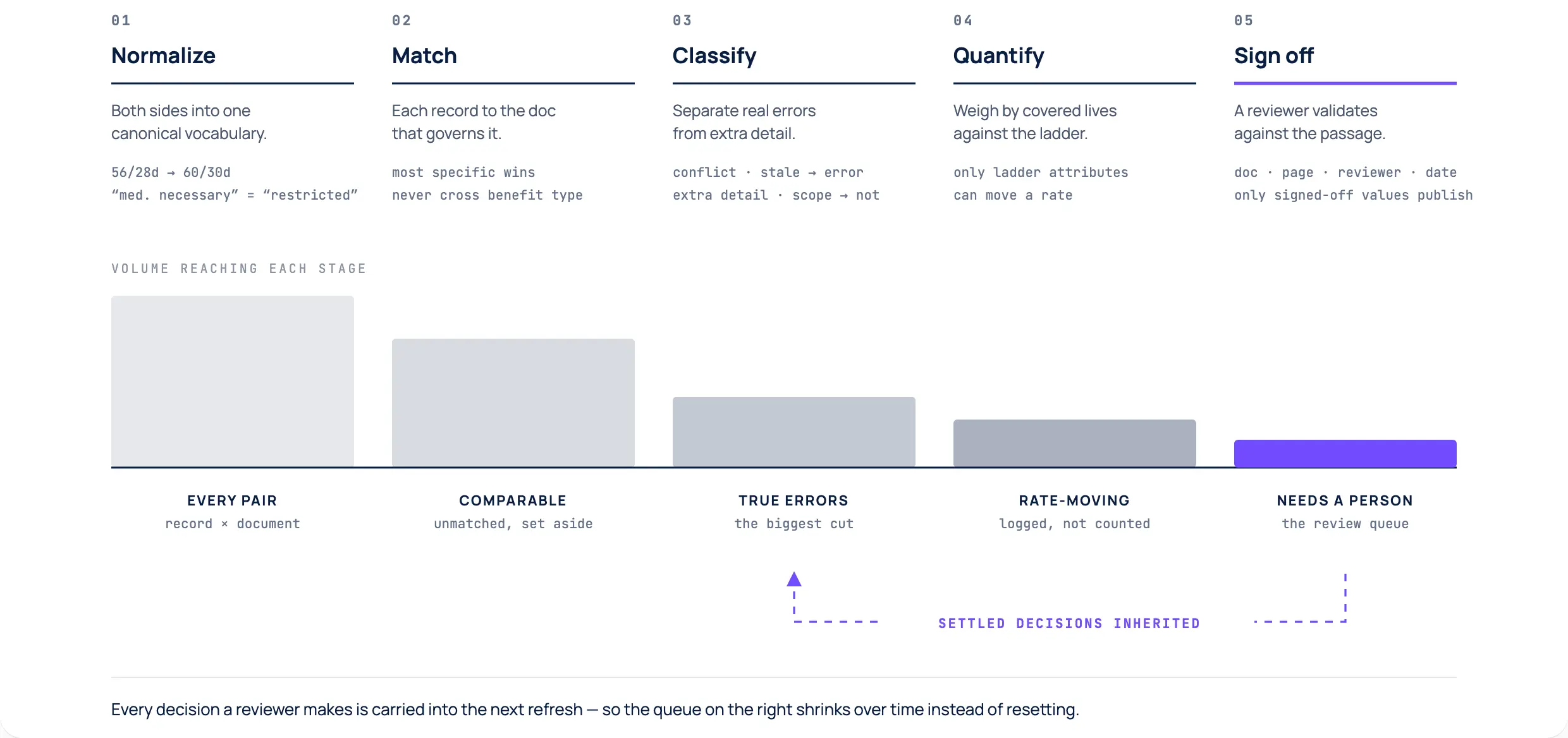
Everything in that workflow reduces to five checks, run in order. If you skip one, the output becomes noise.
Normalize → Match → Classify → Quantify → Sign off.
1. Normalize
Convert both sides into one canonical set of coverage attributes before comparing anything.
This set covers coverage status, formulary tier, prior authorization, step therapy (required, plus how many agents and which), quantity limit, age minimum and maximum, diagnostic requirements, prescriber specialty, site of care, reauthorization interval, benefit type, and effective dates.
Five rules do most of the work:
- Convert every quantity limit to a per-30-day equivalent.
- Map coverage status language on both sides onto one ordered scale.
- Express step therapy as required-or-not, plus a count.
- Convert all ages to years.
- Preserve not held as its own distinct value; never as a zero and never as a stated negative.
2. Match
Match each coverage record to the documents that govern it, using product, payer entity, channel, benefit type, and an effective-date window.
- Match at the level the document governs. A policy covering one state subsidiary must never be compared against a record rolled up to the parent.
- Where several documents could match, the most specific one wins.
- Pharmacy records match pharmacy formulary documents. Medical records match medical policies. Never cross them.
- Treat many-documents-to-one-record as the normal case, not the exception.
- If nothing matches, classify as no document. Never treat an unmatched record as agreement.
3. Classify
This is where most homegrown attempts fall apart. Differences require separate classifications; treating them alike destroys trust in the exercise.
Extra detail must never enter a conflict number. A policy stating a reauthorization interval your dataset has no field for is additional information, not a disagreement. In the illustrative workflow, it is the largest category by covered lives. Counting it would dominate the headline figure and make a healthy dataset look broken.
A stale record is a current error. Anything published before the next refresh uses the old value. Labelling it "no action needed" is how a known discrepancy reaches a forecast.
4. Quantify
Only some attributes can move an access rate. Whether a life counts as having open access depends on a defined ladder of restrictions, with each life placed at its most restrictive requirement.
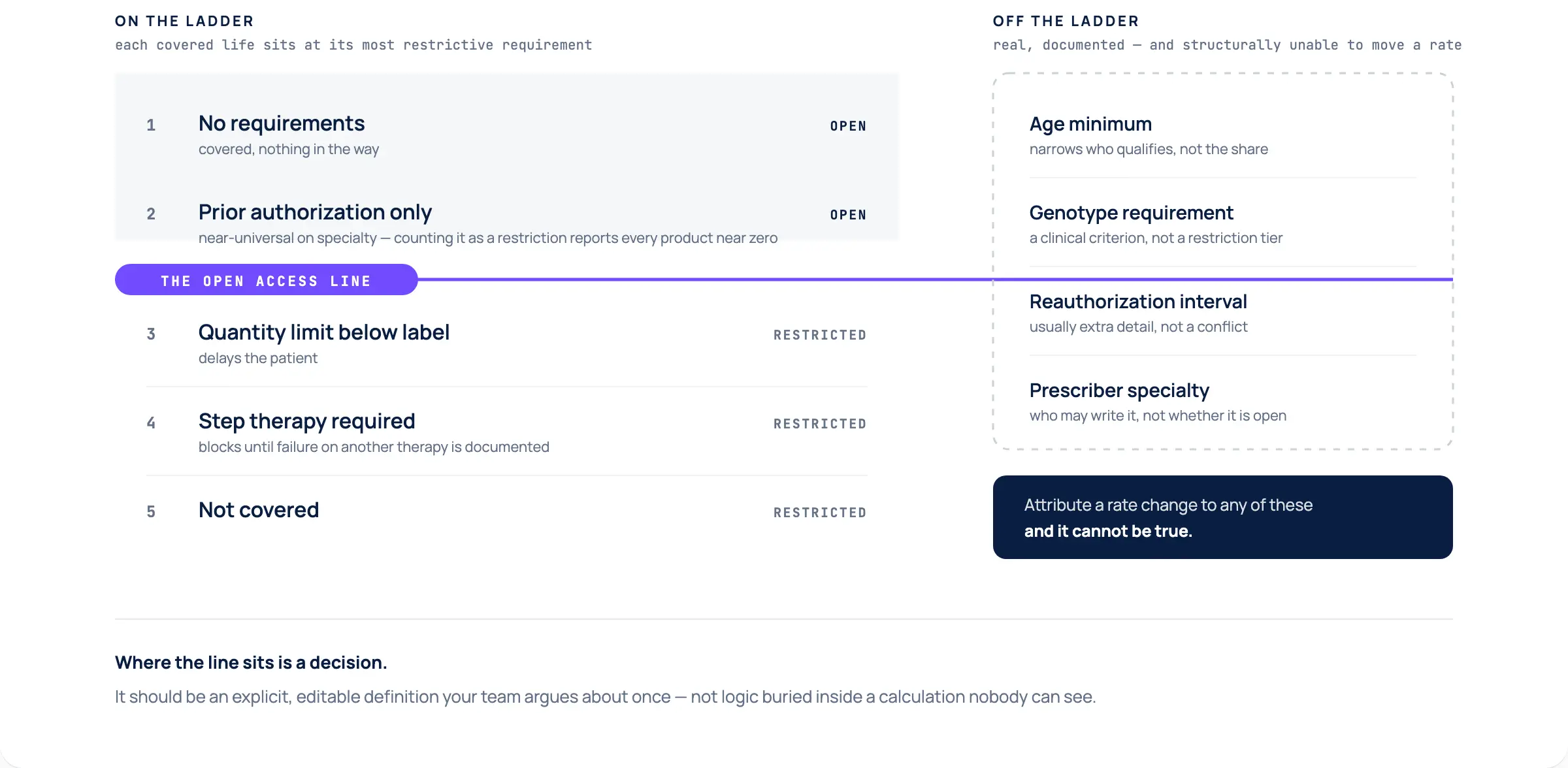
The open-access definition should be explicit and editable. In this model, standard prior authorization sits inside open access. That is a business definition, not a universal standard. On specialty products, counting standard PA as closed access can report nearly every product near zero and hide more meaningful differences. Step therapy is treated as more restrictive than a quantity limit because it requires documented failure on another therapy.
Only attributes included in the organization's access ladder should move its published access rate. Under the ladder above, an age minimum, genotype requirement, reauthorization interval, or prescriber specialty is reported as a finding but does not change the rate. Everything outside the ladder is labelled moves nothing so reviewers can distinguish an important policy detail from a rate-changing correction.
5. Sign off
Detection and correction belong to different people, on purpose.
The analytics team that publishes the numbers proposes corrections. A separate reviewer validates or rejects each one against the exact policy passage, page, and date. Only signed-off values reach reporting. Anything still in review reads as the original structured value.
The audit trail makes the correction defensible. When a published access rate is challenged three months later, the supporting record should include a source document, page number, reviewer, and date.
A validation program should retain settled reviewer decisions. When a reviewer confirms that a payer's step therapy matches the dataset, the next refresh can inherit that known exception with a named owner and re-check date. The queue requiring human review should shrink as those decisions accumulate. A flat queue indicates that prior decisions are not being reused.
The one case where correcting the record is the wrong move
If every document addressing a field says the same thing and the dataset disagrees, the structured value is simply wrong. A straight correction fixes it.
If the payer's own documents contain different rules across subsidiaries or lines of business, the structured record is too coarse. Correcting it to any single value trades one error for another. Those records should be flagged as unverifiable.
How this differs from formulary change monitoring
These two get conflated constantly, and they solve different problems.
Monitoring tells you a document changed. Validation tells you your published number is wrong. Most teams need both, and the two reinforce each other. A change alert is the signal to revalidate the records that document governs. Our market access analytics hub covers the monitoring and governance side in depth, including versioned snapshots and change alerting.
Where Tellius fits
Tellius gives pharma commercial teams an AI worker that shows up with the work done. It runs on an Enterprise Brain grounded in the organization's data, definitions, and business context.
For market access, payer policy validation can run as a recurring Mission grounded in formulary tiers, prior authorization, step therapy, benefit design, covered lives, and payer hierarchies. It treats the structured coverage data and policy documents as one body of evidence and delivers ranked causes, a correction queue ordered by access impact, and a stated verdict on whether a rate is safe to publish.
The output remains defensible because:
- The math is deterministic. The language model handles policy language while a separate reasoning engine handles dimensional calculations. The same data and rules produce a repeatable answer.
- Each figure carries its evidence. A published correction retains the source document, page, passage, reviewer, and date.
- Reviewer decisions accumulate. Settled exceptions and confirmed positions persist across refreshes instead of resurfacing as new work.
The same AI worker can extend beyond validation.
Missions re-run the investigation instead of refreshing a static report. A team can define a Mission to revalidate the portfolio whenever coverage data refreshes. Kaiya runs the five checks, ranks what moved, and produces the finished artifact. A deck or PDF reaches the people who own the number with the access impact in the subject line, so the exception surfaces without another dashboard to monitor.
Ask a question in plain English through Kaiya and the answer arrives with its provenance attached.
Tellius applies market-access logic to policy documents, structured records, and rate calculations so the output is a reviewable decision rather than a document summary.
Publish access rates you can defend
Coverage drift makes an access rate less reliable with each unvalidated policy change.
A repeatable validation workflow sits between the coverage data and each published rate. It normalizes equivalent rules, separates errors from evidence gaps, quantifies only the attributes included in the access definition, and records reviewer sign-off for each correction.
The access number that survives a challenge is the one with a document, a page, and a signature behind it.
Get release updates delivered straight to your inbox.
No spam—we hate it as much as you do!


Payer policy validation is the practice of checking a structured coverage dataset against the payer policy documents that govern access, measuring how differences change published access rates, and routing corrections through human sign-off. It turns access reporting into a document-backed, defensible number.
Coverage drift is the growing disagreement between a licensed coverage dataset and current payer policy documents. It happens because datasets refresh on a cycle while payers revise policies continuously, so between refreshes some records describe rules that no longer exist.
Monitoring compares one version of a document to the next and tells you what changed. Validation compares your structured dataset to the documents and tells you whether your published number is wrong. Monitoring produces alerts; validation produces corrections and an access impact.
Not necessarily. Even an accurate coverage dataset begins aging as policies change between refreshes. Validation complements the licensed dataset by distinguishing timing-related drift from extraction, normalization, and matching errors.
A policy may state attributes the dataset has no field for, such as reauthorization intervals. In the illustrative workflow, this extra detail is the largest category. Counting it inflates conflict rates and makes a healthy dataset look broken. Only conflicts and stale records need correction.
A conflict means the dataset and policy disagree within the same effective period, or no timing cause has been established. A stale record means they disagree because the policy became effective after the data snapshot. Both need correction.
That depends on the organization's access definition. In the model used here, standard PA remains inside open access because counting it as closed access can report nearly every specialty product near zero and hide more meaningful differences. The rule should be explicit and editable rather than buried in a calculation.
Reading is the easy part. The hard parts are normalizing unit conventions and equivalent status language, matching each record to the governing document, and distinguishing missing data from a stated negative. Without those layers, output is mostly false conflicts.
Because the audit trail is what makes a corrected number defensible. Separating detection from decision means every corrected value carries a reviewer, a source document, a page, and a date, which is exactly what a challenge three months later demands.
State three things together: the share of covered lives with a signed-off position, the access-point value of corrections awaiting review, and the number of lives on records that remain unverifiable. In an illustrative readiness test, a rate resting on 62% document coverage carries a different level of confidence than one resting on 96%.
.webp)
Payer contract analytics: how to size a formulary deal and prove pull-through

Winning favorable formulary access is only the first step in a successful payer strategy. The real challenge is determining whether a contract will generate profitable prescription growth—and proving that improved access translates into measurable pull-through. This guide explains how payer contract analytics enables market access, finance, and commercial teams to model the financial impact of formulary agreements before they're signed and continuously measure performance after launch. Learn how leading organizations combine formulary intelligence, claims, hub services, specialty pharmacy data, and field execution metrics to evaluate rebate effectiveness, forecast contract ROI, monitor payer performance, and identify opportunities to improve pull-through.

Market Access Analytics for Pharma: Detect Payer Changes Before TRx Falls
This blog explains how AI-powered market access analytics helps pharma teams spot payer policy changes—formulary shifts, new PA requirements, and tier moves—within days instead of waiting 60–90 days for claims reports. By combining a pharma-native semantic layer, data federation across formulary, claims, hub, and specialty pharmacy sources, and agentic analytics, the platform automatically investigates access issues, quantifies TRx impact, and delivers finished decks and models. The result is earlier detection, faster performance diagnosis, and field activation while there’s still time to protect scripts and pull through new access wins.